
Russia’s war in Ukraine is now in its fifth year and, despite the growing impatience of Donald Trump, a breakthrough in peace talks looks a long way off. Yet even when the fighting does end, it will not represent a conclusion. Rather, it will mark the start of a considerable new challenge: reconstruction.
The crucial questions are not only how much reconstruction will cost, but also how it can be financed and whether Ukraine will have the skilled workforce needed to carry it out. Millions of Ukrainian citizens have left the country since the start of the 2022 invasion.
A further test will be whether Europe, which became Ukraine’s largest provider of military and financial assistance in 2025, can maintain the political unity needed to see reconstruction financing through in the long term.
1. Closing the funding gap
Ukraine’s reconstruction needs are enormous. According to figures released by the World Bank on February 23, the total cost of reconstruction and recovery in Ukraine will be around US$588 billion (£435 billion) over the next decade. This will only rise as the war drags on.
In an attempt to meet this figure, Ukraine and its allies are seeking to mobilise private capital. This has involved Ukraine’s parliament adopting a new public-private partnership law in June 2025 to incentivise private-sector participation in the reconstruction of economic sectors such as energy and transportation.
A war-risk insurance mechanism was also rolled out that year. Supported by the European Bank for Reconstruction and Development, it provides private companies that invest in Ukraine’s reconstruction with protection against war-related damages.
However, irrespective of these developments, the level of investment in Ukraine is likely to fall far short of what the country requires. In 2024, Ukraine attracted roughly US$3 billion of foreign direct investment, with reinvested profits making up the largest proportion. Data published by Ukraine’s central bank suggests this figure will drop in 2025.
A foreign investor sentiment survey from 2025 found that only 49% of members of the Global Business for Ukraine and the European Business Association, two groups of international companies focused on supporting and rebuilding Ukraine’s economy, are actually investing in the country. Nearly 70% of those surveyed cited the volatile security situation, which is likely to continue after the war, as the main barrier to investment.
Nearly 50% of those surveyed pointed to corruption, policy uncertainty and weak institutional capacity as barriers, while 34% voiced concerns about the strength of the rule of law. These are governance challenges that predate Russia’s 2022 invasion.
Ukraine’s ability to attract more private investment after the war will thus not only depend on the terms of the peace deal. It will also depend on how effectively the country manages to strengthen its institutions.
Private capital will play a role in Ukraine’s reconstruction. But its flows are far from guaranteed. So the donors and financial institutions that have sustained Ukraine throughout the war, such as the World Bank, International Monetary Fund and the European Investment Bank, will probably have to play a leading role in financing Ukraine’s longer-term recovery.
2. Encouraging Ukrainians to return
Nearly 6 million Ukrainians remain displaced abroad as a result of the war. There is no guarantee that these people, many of whom have spent years integrating into the labour markets and education systems of their host countries, will choose to return to Ukraine when the hostilities end.
Labour shortages, both skilled and unskilled, are one of the key challenges currently facing companies in Ukraine. And foreign investors have also cited labour availability as an important factor influencing their decision about whether to invest in the country’s reconstruction.
Encouraging Ukrainians to return voluntarily will require more than patriotic appeals: it will depend on there being viable employment prospects, functioning public services and credible security guarantees in place to prevent a resumption in the conflict.
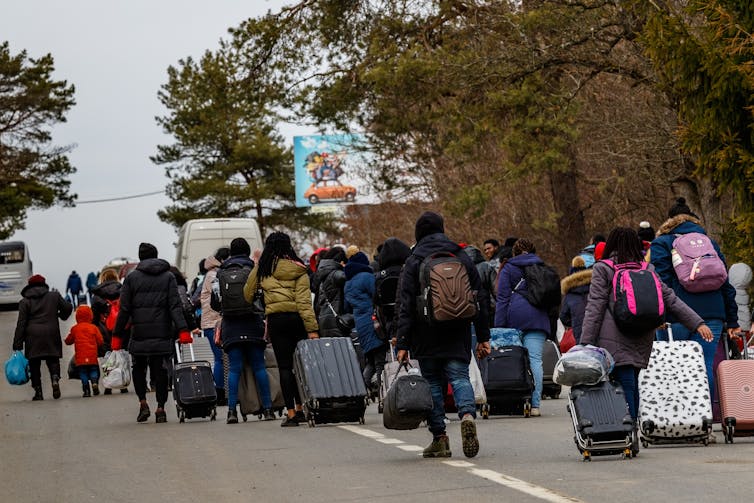
Ukrainian refugees approach the border with Slovakia in the early days of Russia’s full-scale invasion.
Yanosh Nemesh / Shutterstock
The Ukrainian government has begun taking steps to maintain connectivity with the diaspora. This has included opening so-called “unity hubs” aimed at sustaining ties with the refugees and facilitating their voluntary return. One such hub opened in Berlin in 2025.
Ukraine’s authorities are also developing a portal designed to connect refugees with employment and business opportunities at home. However, these initiatives remain in their early stages and uptake remains to be seen.
Without the return of refugees, Ukraine risks developing a structural skills deficit. Such a shortfall could deter private investment in the country’s reconstruction and lead to a reliance on external labour.
3. European political commitment
There is also a political dimension to the challenges associated with reconstructing Ukraine. Sustaining long-term support for the country’s reconstruction may become more complicated amid shifting political dynamics across Europe.
The consensus among European countries on supporting Ukraine has largely held. But upcoming parliamentary and presidential elections in France, Italy, Denmark and elsewhere in 2026 and 2027 could shift the balance of power in key allied countries.
The elections are, at the very least, likely to absorb political attention and divert focus from unresolved questions. These include questions around the use of frozen Russian assets to finance Ukraine’s reconstruction, where agreement remains elusive.
Signs of fracture are also beginning to emerge. The EU has looked to push through a €90 billion loan to cover Ukraine’s needs for 2026 and 2027. Three countries – Slovakia, the Czech Republic and Hungary – abstained from the deal over the closure of an important oil pipeline in Ukraine. And Hungary now appears to be holding up the loan.
Reconstruction will be a test of political endurance as much as financial capacity. The question that will arise after any peace deal is reached is not only how to fund Ukraine’s recovery, but whether its allies can sustain the political consensus required to do so over time.


